
Views: 0 Author: Site Editor Publish Time: 2026-10-07 Origin: Site


Commercial and utility-scale solar sectors are rapidly transitioning away from traditional full-cell architectures. Standard module efficiency has hit strict physical limits. Project developers and EPCs face compounding challenges in maximizing energy yield across diverse site conditions. You must mitigate resistive losses, manage thermal degradation, and maintain output in shading-prone environments without exponentially increasing Balance of System (BOS) costs. We see standard panels failing to deliver expected yields when subjected to high ambient temperatures or tight inter-row spacing. Field data consistently shows that legacy designs struggle with localized heat buildup. Altering the physical architecture of the cell via precision laser-cutting fundamentally changes the electrical and thermal dynamics of the module. By splitting the internal circuitry, modern modules bypass these physical constraints. Upgrading to a half cut solar panel directly addresses these bottlenecks. This guide evaluates how halving the cell impacts overall performance, reliability, and project ROI.
Reduced Resistive Losses: By halving the electrical current passing through the busbars, half-cut cells reduce I²R (power) losses by up to 75%, directly increasing module efficiency and output.
Superior Shade Tolerance: The split-panel wiring design allows the top and bottom halves of the module to operate independently, preserving up to 50% of power output during partial shading events.
Enhanced Thermal Profile: Lower internal currents generate less heat, reducing the risk of hot spots and improving the temperature coefficient for better performance in high-heat environments.
Utility-Scale Viability: The shift toward ultra-high-output modules (e.g., 700W+) relies heavily on half-cut architecture to balance high power density with mechanical stability and manageable degradation rates.
Standard solar cells face a strict physical bottleneck. Increasing cell size to boost power inherently increases internal resistance and heat generation. When a full-size cell generates high current, the metallic ribbons carrying that current experience significant resistive drag. This drag converts potential electrical energy into wasted heat. Pushing standard cell dimensions larger simply amplifies this thermal penalty. You end up limiting the maximum achievable output of the entire array. Field engineers frequently observe this limitation during peak summer months. Modules run hot, voltage drops, and the inverter clips earlier than modeled. We need a mechanical solution to an electrical problem. The industry cannot simply keep making standard cells larger without addressing the current-handling limitations of the busbars.
Manufacturers resolve this bottleneck by physically dividing standard cells into two equal halves. This requires high-precision laser scribing. The manufacturing process utilizes advanced lasers to create a microscopic groove across the cell surface. The cell is then cleaved cleanly along this line using thermal stress or mechanical separation. Clean cuts are mandatory. Jagged edges or micro-fissures introduce structural weaknesses. These flaws propagate into microcracks during field deployment when the module flexes under wind loads. Precision laser cutting ensures long-term reliability. It maintains the structural integrity required for decades of environmental exposure. Factory calibration dictates field survival. If the laser power is too high, it damages the p-n junction. If it is too low, the cleavage is uneven.
Halving the physical cell fundamentally alters the physics of the electrical current. Power loss in a circuit is proportional to the square of the current multiplied by resistance (I²R). When you cut the cell in half, you cut the current produced by that specific cell in half. Squaring a halved current results in a quarter of the original value. Therefore, halving the cell reduces resistive losses on the ribbon by a factor of four. This 75% reduction in resistive loss translates directly into higher usable energy output at the module terminals. We measure this as a tangible bump in string voltage. The electrons face less traffic on the busbars, allowing more energy to reach the combiner box.
Standard panels wire all cells in a single continuous series string. Half-cut architectures split the internal circuitry into twin parallel sections. The top half of the panel operates on one series string. The bottom half operates on another. These two strings then connect in parallel at the center junction box. This split fundamentally alters how bypass diodes interact with the cell strings. Instead of shutting down an entire third of the panel when a single cell is obstructed, the parallel design isolates the impact. It preserves the output of the unshaded sections. The center-mounted junction box also requires shorter internal cabling, further reducing internal resistance.
The primary metric for evaluating solar panel module performance is the conversion of sunlight into usable AC power at the inverter. The reduction of thermal loss on the ribbon translates to a measurable increase in module power. Field data typically shows a 2-3% baseline gain over standard full-cell equivalents. Over a multi-megawatt installation, this seemingly small percentage compounds into massive gains in lifetime energy yield. The recovered energy directly improves the financial modeling of the site. You get more kilowatt-hours per acre. This efficiency boost is particularly noticeable during high irradiance periods when standard modules would otherwise suffer from severe resistive clipping.
Lower operating current correlates directly with reduced operating temperatures. Solar cells lose efficiency as they heat up. We track this metric via the temperature coefficient. Because half-cut cells generate less internal resistive heat, the entire module runs cooler. This cooler operating state improves the temperature coefficient. It allows the panel to maintain higher voltage during peak summer months. Furthermore, mitigating localized heat buildup drastically reduces the risk of hot spots. Hot spots are a primary driver of long-term backsheet degradation and premature module failure. A cooler module also extends the lifespan of the encapsulant materials, preventing yellowing and delamination over the 25-year design life.
Utility and commercial sites frequently encounter inter-row shading during early morning or late afternoon hours. The operational advantage of the split-module design becomes obvious here. When the bottom half of the panel is shaded, the top half continues to produce power. Standard panels subjected to the same bottom-row shading drop their output almost entirely. Their bypass diodes trigger to protect the string. This independent operation makes half-cut designs exceptionally resilient against localized soiling. They handle snow accumulation along the lower frame and tight row spacing with minimal yield loss. In agricultural settings where dust settles on the lower edge, the top half remains uncompromised.
External factors like sunlight intensity, module direction, tilt, and load resistance interact dynamically with the half-cut architecture. The split-circuit design ensures that sub-optimal tilt or directional shading has a less detrimental impact on overall yield compared to standard modules. If a site requires a low tilt angle to maximize ground coverage ratio, the resulting edge-soiling will only impact the lower circuit. The upper circuit continues operating at peak efficiency. This stabilizes the voltage delivered to the inverter and keeps the string within optimal Maximum Power Point Tracking (MPPT) windows. Inverters track the power curve much more effectively when the voltage remains stable despite partial shading.
Mechanical stress distribution is a heavily scrutinized evaluation dimension. Wind uplift and heavy snow loads cause panels to bow and flex. Standard full-size cells span a larger surface area. This makes them highly susceptible to snapping under mechanical bending. Smaller cell surface areas experience less mechanical bowing. The reduced physical span of a half-cut cell allows it to ride out the flex of the glass and frame without fracturing. This drastically reduces the propagation of microcracks. It preserves the electrical pathways over the project's lifespan. Field inspections using electroluminescence imaging consistently show fewer inactive cell areas in half-cut arrays after severe weather events.
The industry standard for large-scale deployments was historically the 72-cell format. Today, the direct upgrade is the 144 cell half cut solar module. While a 120-cell half-cut variant exists to replace the standard 60-cell format for projects with specific spatial or weight constraints, the 144-cell dominates the utility sector. Comparing these two approaches reveals stark differences in how they handle current, heat, and physical stress under identical environmental conditions. The transition is not merely a trend; it is a necessary evolution to support larger wafer sizes like M10 and M12.
A primary goal in site design is maximizing active surface area while minimizing inactive white space. The 144-cell configuration achieves this beautifully. It functions as a high efficiency monocrystalline solar panel without requiring a significantly larger mounting footprint than the legacy 72-cell. Engineers pack more active silicon into roughly the same frame dimensions. This high power density means you extract more watts per square meter of racking. You optimize land use and structural steel requirements. When land acquisition costs are high, maximizing the megawatt-per-acre ratio dictates project viability.
Electrical compatibility is mandatory when upgrading site designs. The 144-cell module maintains a similar voltage profile to a legacy 72-cell module despite doubling the cell count. Because the two halves are wired in parallel, the voltage remains stable while the current handling improves. This ensures complete compatibility with standard string inverters, central inverters, and existing DC cabling infrastructure. You do not need to redesign your string lengths or upgrade your combiner boxes to accommodate the new architecture. The open-circuit voltage (Voc) and short-circuit current (Isc) align perfectly with standard 1500V system designs.
Evaluating the shift requires weighing trade-offs. Half-cut manufacturing introduces slight increases in complexity. There are twice as many solder joints and a more intricate junction box layout. However, these minor manufacturing adjustments are heavily outweighed by the substantial gains in lifetime energy yield. The reduction in resistive losses, superior shade tolerance, and extended mechanical lifespan provide a definitive advantage in long-term financial modeling. The slight premium in upfront module cost is rapidly recovered through higher energy generation in the first few years of operation.
Specification Metric | Legacy 72-Cell Module | 144-Cell Half-Cut Module |
|---|---|---|
Internal Current (I) | 100% (Full Current) | 50% (Halved Current) |
Resistive Power Loss (I²R) | Baseline | Reduced by 75% |
Shade Tolerance (Bottom Row) | 0% Output (Bypass Diode Active) | 50% Output (Top Half Active) |
Microcrack Susceptibility | High (Large Surface Area) | Low (Reduced Cell Span) |
Operating Temperature | Higher (More Internal Heat) | Lower (Reduced Resistive Heat) |
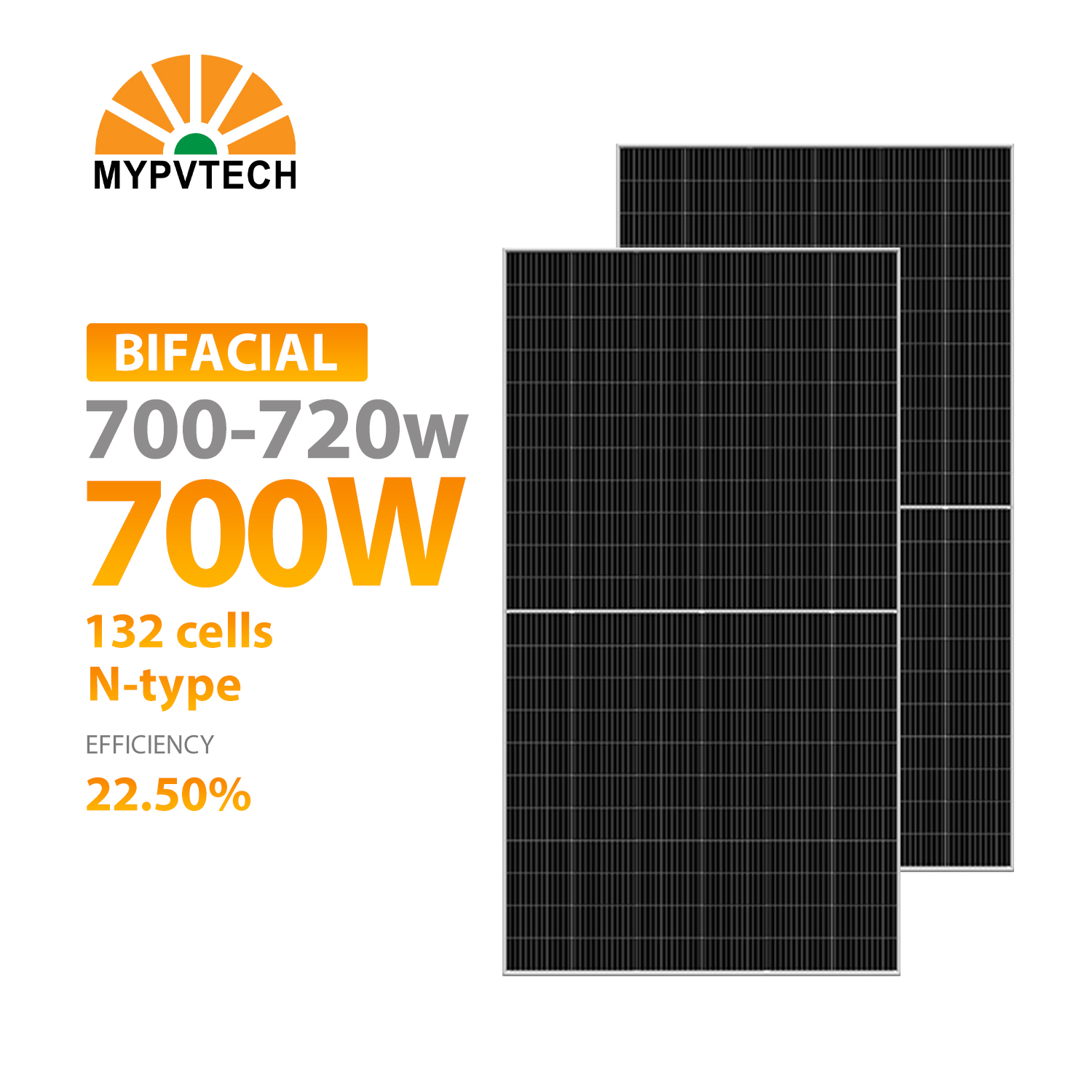
The push for higher energy density has led to the development of ultra-high-output modules. Reaching the 700W+ threshold is physically impossible using standard full-cell designs. Standard cells utilizing large M12 (210mm) wafers generate massive amounts of current. Pushing 18 amps or more through a standard ribbon causes catastrophic thermal losses. It risks melting the junction box and degrading the encapsulant. The 700W 720W half cell solar panel solves this by halving that massive current. It keeps thermal generation within safe, manageable limits for utility-scale applications. These massive modules are engineered specifically for single-axis trackers and fixed-tilt ground mounts.
Ultra-high-power modules fundamentally alter site economics. By deploying 700W+ panels, developers reduce the total number of modules required per megawatt of capacity. Fewer panels mean fewer racking attachments. You install fewer clamps and dig less DC trenching. This velocity increase lowers labor hours significantly. The compounding reduction in structural steel, copper cabling, and installation time drives down the Levelized Cost of Energy (LCOE). It drastically improves project margins. When you handle fewer physical units, logistics, shipping, and on-site staging become much more efficient.
Half-cut architecture does not operate in isolation. It acts as a foundational multiplier when combined with advanced cell technologies. Whether layered over Passivated Emitter and Rear Cell (PERC) or modern Tunnel Oxide Passivated Contact (TOPCon) designs, the half-cut format maximizes their inherent efficiencies. TOPCon cells already excel at electron capture. Cutting them in half ensures those captured electrons travel to the inverter with minimal resistive drag. This synergy pushes theoretical efficiency limits into practical field realities. Bifacial variants of these modules see even greater benefits, as the rear-side generation does not overwhelm the internal busbars.
The primary risk in half-cut technology lies entirely in the factory. Edge damage during the laser cutting process is the primary failure point. If the laser calibration is slightly off, it creates microscopic thermal stress fractures along the cut line. Poor quality control allows these compromised cells to enter the field. They lead to premature degradation and severe power loss within the first five years of operation. You must ensure the factory uses non-destructive laser ablation techniques to preserve the silicon lattice structure.
Mitigating manufacturing risk requires strict vetting. When evaluating a high power solar panel manufacturer, demand transparency regarding their production lines. Verify their automated laser scribing capabilities and thermal management during the cut. Mandate comprehensive Electroluminescence (EL) testing protocols to identify hidden microcracks before shipping. Furthermore, rely heavily on third-party reliability certifications. Reviewing PVEL (PV Evolution Labs) scorecards provides independent verification of the manufacturer's thermal cycling and mechanical load resilience. Do not accept internal factory testing as the sole proof of quality.
Bulk procurement strategies must prioritize long-term bankability over upfront cost. When sourcing wholesale solar panels, scrutinize the Bill of Materials (BOM). Ensure the encapsulants and backsheets are rated for the extended thermal lifespan of the half-cut cells. Polyolefin Elastomer (POE) is often preferred over Ethylene Vinyl Acetate (EVA) for these high-power modules due to its superior moisture resistance. Analyze warranty terms carefully. Distinguish between product defect warranties and linear performance guarantees. Finally, confirm the financial bankability of the manufacturer. You need assurance they will remain operational to honor those warranties decades down the line.
Request the complete BOM from the manufacturer to verify encapsulant and backsheet quality.
Review independent PVEL scorecards for thermal cycling and mechanical stress test results.
Audit the factory's EL testing procedures to ensure 100% of modules are scanned post-lamination.
Verify the warranty terms explicitly cover excessive degradation caused by microcrack propagation.
Confirm the physical dimensions of the modules match the tolerances of your selected racking system.
Project developers should default to half-cut architectures for any site with shading risks, high ambient temperatures, or strict Levelized Cost of Energy targets. To execute your procurement and engineering phases effectively, follow these immediate steps:
Request comprehensive EL testing data and bankability reports from all shortlisted module manufacturers.
Model the specific shade profile of your site using half-cut module PAN files in PVsyst to quantify the exact yield advantage.
Audit the manufacturer's Bill of Materials to verify encapsulant quality aligns with the expected thermal lifespan of the module.
Update your structural racking specifications to accommodate the precise frame dimensions of 144-cell formats.
A: Standard panels use full-size square cells wired in a single continuous series. A half cut solar panel uses cells cut in half with a precision laser. This doubles the cell count and splits the panel into two parallel circuits, which drastically reduces internal resistance and improves shade tolerance.
A: Because the panel is wired in two independent halves, shading on one half does not shut down the entire panel. If the bottom row is shaded by an adjacent rack, the unshaded top half continues to produce power, preserving up to 50% of the module's output.
A: Cutting the cell in half reduces the electrical current passing through the internal busbars by 50%. Since power loss is calculated as I²R (current squared times resistance), halving the current reduces the resistive power loss by exactly 75%.
A: A 120-cell half-cut module is the upgraded version of a standard 60-cell panel, often used in commercial settings with strict space or weight constraints. A 144-cell module replaces the standard 72-cell panel, offering a larger footprint and higher power output ideal for utility-scale projects.
A: Generally, no. These ultra-high-power modules are physically much larger and heavier than standard panels. They are designed specifically for utility-scale and large commercial ground-mount installations to optimize structural steel and labor costs.
A: When manufactured correctly by a reputable high power solar panel manufacturer, laser cutting does not reduce lifespan. The smaller cell size actually makes them more resistant to mechanical stress, wind loads, and microcracking, potentially extending field life.
A: Lower internal currents result in significantly less electrical heat generation. This lowers the overall operating temperature of the module, reducing the risk of localized hot spots and improving overall energy conversion efficiency in warm climates.


